
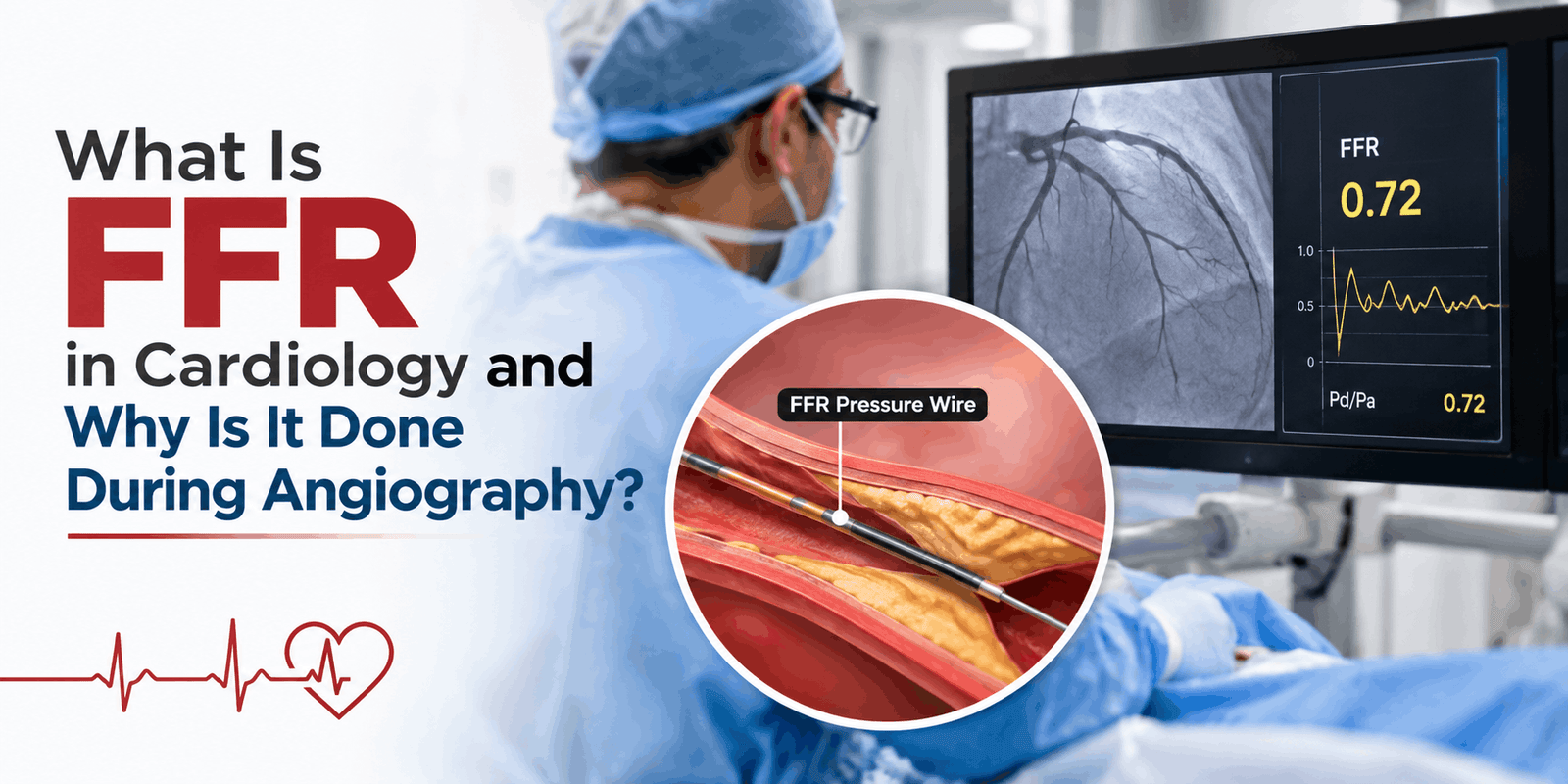
If you have been advised to undergo coronary angiography, you may hear your cardiologist mention a test called FFR. But what does it mean, and why is it sometimes performed during angiography? What Is FFR in Cardiology and Why Is It Done During Angiography? FFR, or Fractional Flow Reserve, is a pressure-based test used to determine whether a narrowing in a coronary artery is significantly reducing blood flow to the heart muscle.
FFR can help an interventional cardiologist decide whether a coronary artery blockage needs treatment, such as angioplasty and stent placement, or whether medical treatment may be appropriate.

FFR stands for Fractional Flow Reserve. It is a measurement used during coronary angiography to assess the effect of a narrowing inside a heart artery.
An angiogram can show where a blockage or narrowing is located and how narrow the artery appears. However, the appearance of a blockage does not always tell doctors how much it is affecting blood flow.
FFR provides additional information by measuring the pressure before and after a coronary artery narrowing. This helps the cardiologist understand whether the narrowing is likely to limit blood supply to the heart muscle.
In simple terms, FFR helps answer an important question:
Is this artery narrowing actually restricting blood flow enough to require treatment?
FFR is generally considered when an angiogram shows a coronary artery narrowing whose importance is uncertain.
For example, an artery may appear moderately narrowed on an angiogram. The cardiologist may want to know whether this narrowing is actually reducing blood flow significantly before recommending a procedure.
During FFR, a specialised pressure-sensing wire is carefully passed through the coronary artery. The cardiologist measures pressure across the narrowed area, often while increasing blood flow through the heart’s coronary circulation using a medication.
The pressure measurements are then used to calculate the FFR value.
This additional information can help guide treatment decisions and avoid treating a blockage that may not be responsible for reduced blood flow.

FFR is usually performed during coronary angiography, so a separate major procedure may not be necessary.
The general process includes:
The procedure is performed by a trained interventional cardiology team under appropriate monitoring.
FFR provides a physiological assessment of a coronary artery narrowing. Traditionally, an FFR value of 0.80 or below has commonly been used as a threshold supporting that a lesion is functionally significant, although treatment decisions should not be based on a number alone.
An FFR value above this range may suggest that the narrowing is not causing a significant reduction in blood flow under the conditions tested.
However, the cardiologist also considers the patient’s symptoms, other investigations, location of the blockage, overall heart health, and clinical circumstances.
This is why FFR is a decision-support tool rather than a standalone diagnosis.
Angiography and FFR provide different types of information.
Coronary angiography primarily shows the anatomy of the coronary arteries. It can identify the location and visual appearance of a narrowing.
FFR evaluates the physiological effect of that narrowing on blood flow.
For some patients, angiography provides enough information to guide treatment. In other cases, particularly when the severity of a narrowing is uncertain, physiological assessment such as FFR may provide useful additional information.
Using both anatomical and physiological information can help the cardiologist develop an appropriate treatment plan.
Yes. One important use of FFR is helping cardiologists determine whether an intermediate coronary artery narrowing is likely to benefit from revascularisation.
If testing suggests that a narrowing is significantly affecting blood flow and the patient’s clinical situation supports intervention, angioplasty may be considered.
If the narrowing does not appear to significantly restrict blood flow, the cardiologist may consider continuing or optimising medical treatment instead, depending on the patient’s overall condition.
For patients looking for Best Angioplasty in Mumbai it is important to focus on evaluation by a qualified cardiology team and on whether angioplasty is clinically appropriate rather than choosing a procedure based only on the appearance of a blockage.
FFR may be considered when:
The decision depends on the individual patient and should be made by the treating cardiologist.
FFR can provide useful information about whether a coronary narrowing is affecting blood flow. Its potential benefits include:
Patients should discuss the expected benefits, risks, and alternatives with their cardiologist before undergoing the procedure.
FFR is an invasive procedure because it is performed through a catheter placed inside a coronary artery. Like other catheter-based cardiac procedures, it can have risks.
Possible complications can include bleeding or bruising at the access site, blood vessel injury, abnormal heart rhythms, allergic reactions to contrast material, or other complications. Serious complications are uncommon but possible.
Your cardiologist will assess your medical history and explain the risks before the procedure.
If you are being evaluated for coronary artery disease in Mumbai, your cardiologist may recommend angiography, FFR, or other tests depending on your symptoms and test results. Treatment decisions should be based on a complete cardiac assessment.
Patients researching the cost of angioplasty in Mumbai should also understand that the total expense can vary depending on the hospital, type and number of stents, procedure complexity, investigations, medicines, and length of hospital stay. It is therefore useful to ask the hospital for a detailed estimate rather than relying on a single quoted figure.
When selecting an angioplasty specialist in Mumbai consider the doctor’s qualifications, experience with interventional procedures, hospital facilities, and the availability of appropriate cardiac care.
For information about Dr Amit Patil and his cardiology services, patients can also explore the clinic’s information about a Best Heart Surgeon and related cardiac care services.
FFR is an important tool that can provide additional information during coronary angiography. By measuring pressure across a coronary artery narrowing, it can help cardiologists understand whether a blockage is significantly affecting blood flow and assist in treatment planning.
Like any medical procedure, angiography or related cardiac procedures may have some risks. These can include mild bleeding or bruising at the access site, blood vessel injury, temporary changes in heart rhythm, or an allergic reaction to the contrast material. Serious complications are uncommon, but they can occur in some cases. An experienced best interventional cardiologist can assess your condition, explain the possible risks, and take appropriate precautions to help ensure the procedure is performed safely.
For patients seeking a best cardiologist for angioplasty in Mumbai or information about the Best angioplasty Hospital in Mumbai the priority should be qualified cardiac care, appropriate